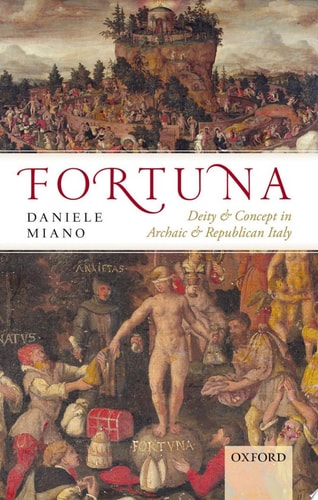
Fortuna
0
0
As an Amazon Associate and affiliate partner, Menrva Books earns from qualifying purchases. Learn more
Author Description
What Is Good Luck And What Did It Mean To The Romans? What Connections Were There Between Luck And Childbirth, Victory In War, Or Success In Business? What Did Roman Statesmen Like Cicero And Caesar Think About Luck? This Volume Aims To Address These Questions By Focusing On The Latin Goddess Fortuna, One Of The Better Known Deities In Ancient Italy. The Earliest Forms Of Her Worship Can Be Traced Back To Archaic Latium, And Though The Chronological Scope Of The Discussion Presented Here Covers The Archaic Age To The Late Republic, She Was Still A Widely Recognized Allegorical Figure During The Middle Ages And The Renaissance. The Primary Reason For Fortuna's Longevity Is That She Was A Conceptual Deity, Symbiotically Connected To The Concept Of Chance And Good Fortune. When Communities, Individuals, And Social Groups Interacted With The Goddess, They Were Inevitably Also Interacting With The Concept: Renegotiating It, Enriching It With New Meanings, And Challenging Established Associations. All The Available Literary, Epigraphic, And Archaeological Sources On Fortuna Are Explored Here In Depth, Including Analyses Of All The Attested Sanctuaries Of The Goddess In Italy, An Updated Study Of Inscribed Gifts Offered To Her By A Variety Of Individuals, And Discussion Of How Authors Such As Cicero And Caesar Wrote About Fortuna, Chance, And Good Luck. This Study Of The Goddess Based On Conceptual Analysis Serves To Construct A Radically New Picture Of The Historical Development Of This Deity In The Context Of The Cultural Interactions Taking Place In Ancient Italy, And Also Suggests A New Approach To Polytheism Based On An Exploration Of The Connection Between Gods And Goddesses And Concepts.
Menrva's Summary
THE THESIS
How did the Roman conceptualization of the goddess Fortuna evolve from the Archaic age through the Late Republic to influence Roman social, political, and personal life? Daniele Miano, a scholar of Roman religion and culture, utilizes a multidisciplinary framework to examine the intersection of divine worship and the abstract concept of chance. By analyzing the symbiotic relationship between the deity and the human experience of luck, the author argues that Fortuna served as a dynamic vessel for Romans to negotiate their understanding of success, victory, and uncertainty.
THE SCOPE MAP
What You Will Find
- Historical analysis of Fortuna worship from Archaic Latium to the Late Republic.
- Examination of literary, epigraphic, and archaeological evidence, including sanctuary sites.
- Study of how prominent figures like Cicero and Caesar integrated the concept of Fortuna into their worldviews.
- Methodological approach to polytheism focusing on the link between deities and abstract concepts.
Scope Limits
- The primary focus is restricted to the period from the Archaic age to the Late Republic.
- The study emphasizes the Italian context, with limited discussion of Fortuna's evolution in the later Roman Empire or post-classical periods.
THE AUTHORITY PERSPECTIVE
Experts recognize this work as a significant contribution to the study of Roman religious conceptualization and the mechanics of polytheism. Readers frequently note the academic rigor and the depth of the primary source analysis provided throughout the text.
Page Count:
264
Publication Date:
2018-01-01
Publisher:
Oxford University Press
ISBN-10:
019109014X
ISBN-13:
9780191090141
History
Religion
Mythology
Ancient - Rome
Cultural History
Community Tags
Similar Books